


We’ve all been there—the sky turns an eerie shade of green, the wind begins to howl, and suddenly, the hum of the refrigerator vanishes. The silence of a power outage is heavy. In those first few minutes, you’re scrambling for flashlights, but in the back of your mind, you’re doing the mental math: How long will the food in the freezer last? Can I keep the Wi-Fi up so I can check the radar? What happens if the grid stays down for a week?
If you’ve started looking into emergency power, you’ve likely run into the great debate: Solar vs. Gas. The solar crowd promises “free” infinite energy and silence. The gas crowd points to “brute force” reliability and high wattage. The truth? If you want to be truly prepared, you shouldn’t be choosing between them. You should be marrying them.
Here is how a hybrid power strategy—combining a dual-fuel generator with a solar power station—creates a setup that is virtually “fail-proof.”
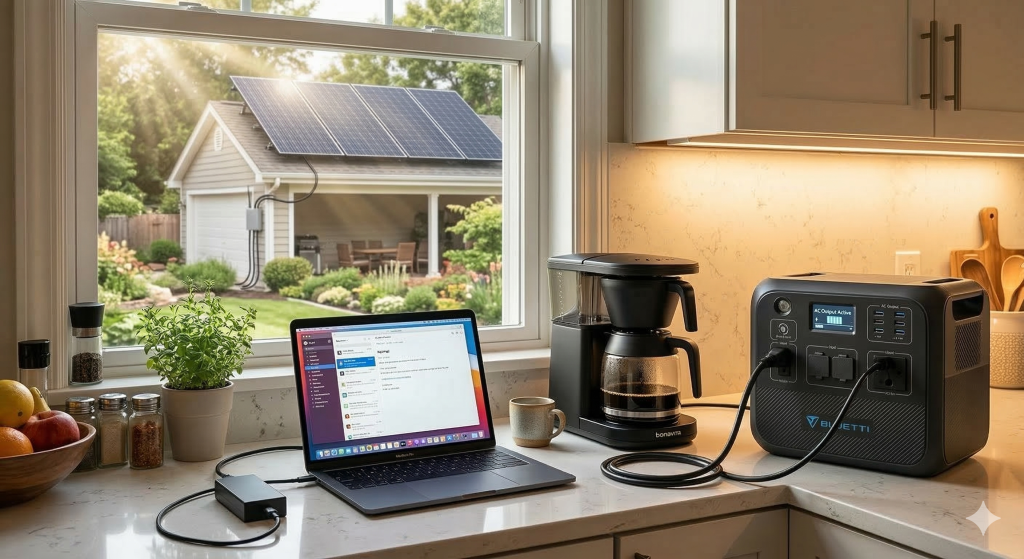
The Silent Daily Driver: Solar Generators (Portable Power Stations)
Portable power stations (often called solar generators) have revolutionized emergency prep. Unlike the noisy, vibrating machines of the past, these are essentially massive, high-tech batteries equipped with advanced “brains” (inverters and charge controllers).
The Pros: Silence is Security
In a long-term grid-down scenario, noise can be a liability. A solar generator allows you to keep your lights on and your Starlink running in total silence. Because there are no fumes, you can keep the unit right next to your bed to power a CPAP machine or in the kitchen for the fridge. If the sun is out, you’re “harvesting” energy for free, making it the ultimate sustainable backup.
The Cons: The Cloud Tax
The weakness of solar is its dependency. A week of heavy overcast or rain in Texas can turn a $2,000 solar generator into a very expensive paperweight. Furthermore, recharging a large battery via solar panels is a slow game—often taking 6 to 10 hours of “perfect” sunlight to hit a full charge.
The Heavy Lifter: Gas and Propane (Dual-Fuel) Generators
When you need to move “heavy” electrons—like starting a window AC unit, running a space heater, or powering a well pump—nothing beats the raw energy density of an internal combustion engine.
The Pros: Power on Demand
A dual-fuel generator is your “break glass in case of emergency” tool. It doesn’t care if it’s midnight or if there’s a blizzard outside; if you have fuel, you have electricity. By choosing a Dual-Fuel model, you get the best of both worlds: the availability of gasoline and the stability of propane. Propane is a prepper’s best friend because it doesn’t degrade over time; you can store a tank for ten years and it will burn just as clean as the day you bought it.
The Cons: The Logistics Nightmare
Gas generators are loud, they require oil changes, and they produce deadly carbon monoxide, meaning they must stay outdoors. More importantly, they are “thirsty.” Running a 3500-watt generator just to charge a cell phone is incredibly inefficient and wastes precious fuel.

The Pro Strategy: Using Gas to “Fast-Charge” Solar
This is where the magic happens. Instead of choosing one, you use the gas generator to support the solar generator. This is a technique used by off-grid experts to maximize fuel efficiency and maintain “stealth” at night.
The Workflow of a Hybrid System
Imagine it’s day three of an outage. It’s been raining all day, and your solar generator is down to 15%. Instead of running a loud gas generator all evening (and wasting fuel while you sleep), you perform a “Bulk Charge”:
1. The High-Wattage Sip: Fire up your dual-fuel generator (ideally on propane) for just one to two hours during the day.
2. The Bridge: Plug your solar generator’s AC charging cable into the gas generator. Most modern power stations can “Fast Charge” at 1,000W or more.
3. The Shutdown: Once your solar battery hits 80%, kill the gas engine. You’ve only used a tiny amount of fuel, but you’ve stored enough “silent” energy to run your lights, fans, and fridge all through the night.
Why This is Superior
• Fuel Stretching: You can make a single 20lb propane tank last for weeks instead of days because the engine is only running for short bursts at its most efficient RPM.
• Tactical Silence: You get to sleep in a quiet house without the drone of an engine outside your window, all while your critical appliances stay powered.
• Reduced Wear: You aren’t putting 500 hours on your generator engine in a single month; you’re only putting on 30 or 40.

Final Thoughts: Diversity is Resilience
In the world of networking and security, we talk about redundancy. In the world of survival, we talk about “P.A.C.E.” (Primary, Alternate, Contingent, Emergency).
By having a solar setup as your Primary and a dual-fuel generator as your Alternate, you create a loop where one compensates for the other’s weaknesses. Don’t wait for the next big storm to realize your single source of power isn’t enough. Start building your hybrid bridge today.
Leave a Reply